新闻动态 > 新闻详情
The Robot's 'Vestibular System': IMUs Put Physical AI on the Move
ASENSING's Inertial Measurement Units (IMU) have been deployed in multiple types of robots showcased at the World Robot Conference 2025 (WRC 2025), held in Beijing from August 8–12. Functioning as the robots' "vestibular system," the IMUs enable precise posture sensing and balance control, ensuring stable performance during operation and movement.
ASENSING is expanding its IMU product portfolio, leveraging its automotive-grade reliability and scalability to accelerate the adoption of high-precision positioning sensors across a wider range of intelligent devices.
Its products have already been deployed to a wide range of robotic systems, including bipedal and wheeled humanoid robots, quadrupedal robots, Automated Guided Vehicles (AGVs), inspection robots, and mobile robot chassis.
IMUs help Physical AI agents maintain balance
The robots showcased at WRC 2025 are typical examples of Physical AI in action, for which perceiving the external environment is an essential capability.
The IMU, which typically integrates a gyroscope and an accelerometer (and sometimes a magnetometer), functions as the vestibular system for these Physical AI agents, while cameras and radars act as their eyes.
By providing precise posture sensing and balance control, IMUs enable various types of robots to operate stably — and also track position changes.
Maintaining bipedal balance is a core challenge for humanoid robots.
With high degrees of freedom in movement and rapid, large-amplitude posture changes, even a minor imbalance can lead to a fall. This necessitates high-frequency, real-time, and precise sensing of subtle changes in the robot's posture, enabling the control system to make immediate adjustments.
Take ASENSING's IMU modules for example.
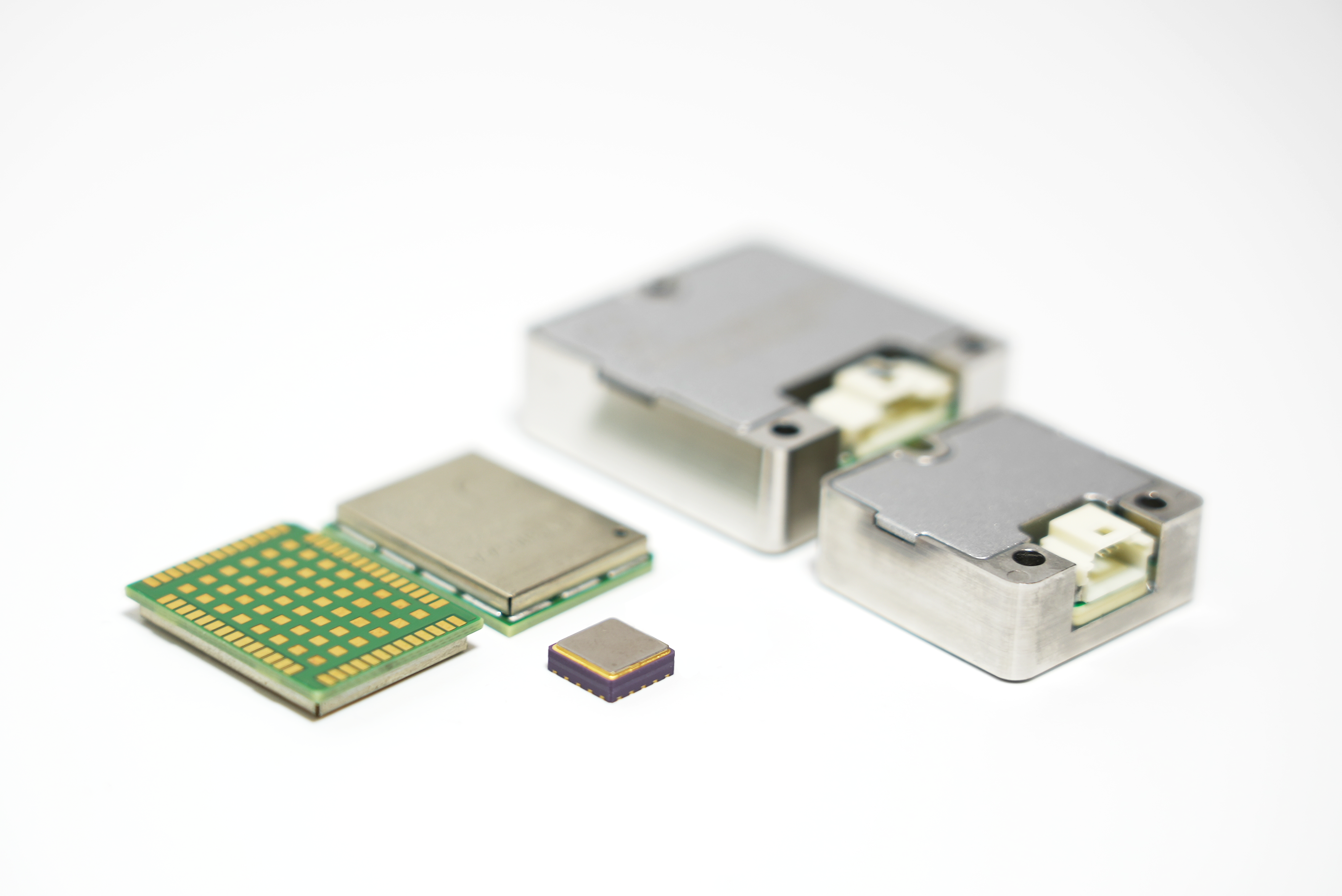
With an attitude output frequency of up to 500Hz, they can capture a robot's tilts and sway in milliseconds. The gyroscope bias instability (Allan variance) of its high-performance IMU modules is ≤0.8°/h, and the accelerometer bias instability is ≤0.02 mg, providing a solid foundation for balance control in complex, dynamic environments.
In industrial robotics, such as AGVs that need to operate autonomously in satellite-denied, obstacle-filled environments, the IMU delivers high-frequency attitude and motion information independent of external conditions. It serves as a cornerstone for positioning, navigation, and intelligent obstacle avoidance.
IMUs also play a crucial role in industrial inspection robots. When vision or radar systems fail due to poor lighting, occlusion, or lack of features, the IMU acts as a "fallback perception" to sustain basic functionality, ensuring mission continuity.
ASENSING's IMU modules undergo full-temperature calibration and feature self-diagnostic capabilities to ensure their own stability, reliability, and availability, which are critical to system safety and maintainability. Additionally, the modules support time synchronization, ensuring correct temporal alignment of sensor data, which is essential for multi-sensor fusion and precise navigation in robotic systems.
Rising global demand for IMUs
The IMU market is booming, both in scale and performance, as autonomous driving and robotics are advancing rapidly.
The global IMU market size is projected to grow from $24.2 billion in 2023 to $67.4 billion by 2032, representing a compound annual growth rate (CAGR) of 12.05%, according to Research and Markets.
更多资讯